Holacracy is about getting things done faster and more effectively. Every person involved not only has a voice, but is called on to participate in full transparency, accountability and capacity towards the goal and vision of the organization.
Beyond Serving Stakeholders
Why does an organization exist? I see several distinct paradigms in operation today, each with a different general answer to that question. Let’s look at some of these with an evolutionary lens, and then bridge to what may be next.

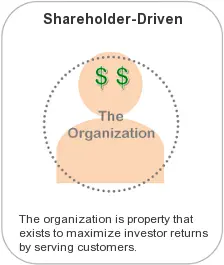
We’re all familiar with the shareholder-driven paradigm, the predominant model in operation today (we’ll focus on for-profits for now, though there are equivalents with non-profits). In its healthy form, the shareholder-model looks at organizations as existing primarily to advance shareholder interests, by providing products and services to customers who consume them.
This paradigm is a major leap forward from the preceding view, which looks something like “the organization exists to maintain the organization and its status-quo” – picture the stereotypical bureaucratic, inward-focused government agency and you’ll get the idea.
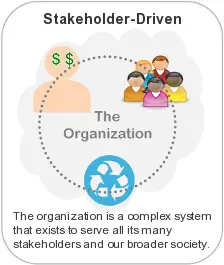
More recently we’ve seen the emergence of a new paradigm, a shift from the shareholder-model to the “stakeholder-model”, which looks at an organization as existing to serve the many stakeholders connected to it, including investors, but also employees, members of the local community, the environment, etc. Several recent studies show that companies operating from this paradigm generate better returns on average for all stakeholders, including investors, compared with those operating from a shareholder-model. However, the stakeholder paradigm isn’t simply an incremental improvement on the prior model, but a fundamental transformation with a qualitatively different mindset and view.
Likewise, I believe there’s a next-step beyond the stakeholder-model, what I’ll call a “transpersonal” model of organization. In this paradigm, the organization is no longer viewed as property, even shared property, here to serve us – even all of us.
Instead of our desires driving the organization, it is driven by its own unique purpose in life – not just a purpose that’s “all about the people”, but one that is genuinely evolutionary, about helping creativity unfold for the sake of the future. The organization is viewed as something akin to a new form of life, and the people involved are its stewards. Their job is to get their own desires out of the way, like healthy parents supporting a child’s journey, so that the organization can express its unique self and deepest creative potential in life.
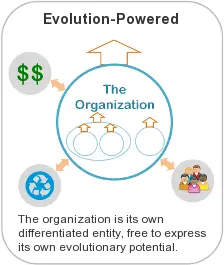
This focus on an evolutionary potential beyond serving human ego is a deep but subtle shift embedded within Holacracy™, and it takes awhile to fully digest. Its processes help to differentiate the organizational entity from the people connected to it, while also integrating them in a new relationship grounded in mutual freedom and support. Where today’s progressive people-centric view of organizations can become narcissistic and self-limiting, Holacracy’s focus offers a more liberating ground – inviting people to serve something larger than themselves, larger even than the collective, for the sake of evolution’s further unfolding. This is the ultimate aim of Holacracy – to liberate the organization to become a direct expression of evolution in action, creativity unleashed, free from the shackles of serving human ego.
Did I lose you? That’s okay – none of this would have made sense to me either before I started my own journey with Holacracy. Fortunately there’s no need to understand or agree with all of my views to use Holacracy to better reach whatever aims you resonate with. I offer my thoughts in the spirit of helpfulness and utility, and invite you to take what you can use and leave the rest.
If you liked this post, share it:
Comments
Interesting notion which I'll have to ponder.
I'm curious, why do you write Holacracy with a trademark?
Brian,
I appreciate the distinctions and the graphics - they help! And you haven't lost me on the aim - that does make sense to me; and on a practical matter I think serving the aim of the evolving organization has the potential to be clearer and simpler than the current model of attempting to serve the aim of what is sometimes countless stakeholders. So I'm good on that point. It's in the detail of how people in an organization discover the aim of the organization where I'm fuzzy. And I know we've had a practitioner’s session on this very topic, and still I'm fuzzy.
I’ve recently done some work and had some limited training perceiving what another individual might be feeling/desiring/experiencing without the usual modes of feedback (the individuals were horses!). While it might be a stretch to relate this to discovering the aim of an organization it has me thinking that we might be able to use a similar process. After all, organizations can’t of themselves talk either.
The first step is to get clear about where you are in that moment (take note of what you are feeling, what’s going on for you in your body, mind, emotions, etc.) and then from that baseline, consciously connect to the other individual/entity – mostly by putting your attention there, and possibly by moving physically closer. Then take note of what changed in your body, mind, and emotions. If you can get good at these things – especially in knowing yourself and connecting with the other, then the difference tends to fall out, to present itself as “not me”. With an individual, even without talking you can get feedback based on taking some action (even if the action is a change in your perceptions of the other) and then sense again if this feels in accord or discord with the other. Where I get stymied in applying this process to an organization is that I have no idea how to connect to, sense or get closer to an organization. I keep seeing an organization as a collection of people, and not an entity unto itself. And some part of me really rails against organizations taking on consciousness or ‘rights’ of their own.
Thoughts?
Brian:
Great to read someone who also sees organizations as "life forms". I even sometimes refer to them as "aliens on earth" ;-) We´re looking for aliens out in space, but there are right here: life forms which we cannot really unterstand, because they are so different from us. They have a fundamentally different consciousness because their very form is so different from us humans and their perception of time is different and much more.
Looking for "little green men" or some alien octopus is still a very anthroprocentric view of the universe. Truely alien life forms probably will be very hard to detect at all. Stanislav Lem described one in "Solaris". And Frank Schätzing in "Swarm" (even though the swarm is living deep down in our oceans).
With organizations, though, we´ve the chance to experience real aliens right here ;-) And even be part of them.
That, to me, is the challenge in shaping this kind of life form. It´s not just an object we can manipulate, but rather something larger than we.
Organizations are on one level of abstraction: the can deal with each other as organizations. That´s like cats dealing with cats.
But then there are the parts of organizations down to us humans. We´re like the cells in a cat or flea.
That´s why it´s hard to "make" an organization to our needs and observe it at the same time. It´s like thinking of cells (or organs) trying to "make" a whole body for their own purpose.
So as you say, we need to see an organization as an individual with its own drive to survive, its own purpose - which is different from our own.
The challenge then is to make the interests of the organization and individual humans´ interests overlap. We need to form a symbiosis, I´d say.
-Ralf
Brian,
I have really been seeing and feeling that there are some organizations that have been birthed because existence "wanted them to be here" in a sense--they arose in an organic way--and they will thrive if they are related to and tuned into as such vs. being based on some series of decisions derived from lots of analysis, ego and the imposition of some ideas on the world. I have been coaching some social entrepreneurs this summer through the Unreasonable Institute, and in working with them, I've begun to play with this notion of tapping into or getting informed by the "entity" or the archetype of the organization. I realize this may sound woo-woo, but I think there is something to it. For example,one of the entrepreneurs is working on a fair-trade type of venture, though the offering is much richer and more relational (between producer and purchaser) than that. She needs to start to ask for a lot more from investors to take this to the next level, and I got intuitively that she needed to really tap into feminine, fertile, generative, wild quality of the land from which they were sourcing their products to embody the appropriateness of that level of ask. As I learned later, her logo is the head of a very feminine, powerful , earthy woman, entirely in brown, which was the vibe I was asking her to take on. I digress here a bit, but I find myself more and more interested in helping birth the organizations that "want to" arise and creating the conditions in which they can emerge and flourish as living "beings" vs. following some textbook checklist.
Deborah
Dear Brian,
I´m one of the co-founders of a community in Germany, that is existing now for 7 years. One of our main principles of decision making is, to get the egos out of the way and listen to the "impulse" of the project. I consider our project to be an entity of itself, similar to the way, you describe the evolution powered organization. In fact almost all of the people that started out in the beginning have left and new people have come, but still the "soul" of the project remains for my sense. What I´m asking myself is, what exactly is the body of this life form? How did it come to existence? Was its birth the moment, we decided to start, or when we bought the place? Will it die, when we leave our activity as a community and sell the property? Or will it remain and go on functioning with the new owners?
The thought "I am" is creating "I entitys" and thus "Identities". How can an organizational entity realize this "I am" ? Is it using the human capacity as a channel and how does it remain, when all leave and new people come?
During my years living in communities I had strong moments of transpersonal expierences while taking group decisions but still these questions remain unanswered to me. Do you have any comments on that?
Dear Brian,
I like your blog and believe you're spot on when you say that we need to go to a next level concerning our reasons to manifest reality and create in the world. Maybe we can even go beyond what you are proposing. I wrote a little something that i would like to share as it seems to relate to what you wrote:
Just because
Some people work to earn a paycheck, so they can buy food, a car and other stuff in order to fulfill their physical needs. Some people work because they need a challenge or want to develop themselves so they can fulfill their emotional needs. Some have a mission and are motivated by helping others or creating a better world, it makes them feel good and worthwhile.
There is nothing wrong with having a reason to act, or having believes about why we act. However, in the final analysis our reasons are merely ‘justifications’, as the causal point of anything created is energy.
Does the sun need a reason to shine? Will he be pissed of when clouds are in its way?
When we are closely connected to our inner core we show up in the world and shine …… just because.
I believe that the more individuals are connected to their core, companies will go to a next level of creating in the world and that we start realizing that the way we are creating now is taking us into a dead end street.
Thanks for sharing your insights
Peter
Hi Brian,
I have just received a message from a friend in Seattle as a reaction to the link I posted on FB. I am pasting the message here and it would be great if you had time to sahre your thoughts on her comments. So here it is:
While I find the Holacracy fascinating, I'm stuck on something he said at the beginning: "This paradigm is a major leap forward from the preceding view, which looks something like “the organization exists to maintain the organization and its status-quo” – picture the stereotypical bureaucratic, inward-focused government agency and you’ll get the idea." It seems, at least in this article, government is dismissed as nothing but self-serving. At its worst this can be true, but with profit removed there can be a value to it that is not unlike the holacracy. This is of course not common but also not impossible. It would take real leadership. But I was disappointed in the dismissal of government right off the bat.“ ... end of quote
I will be happy to guide her to your answer and maybe then she will become a regular visitor here :)
Thanks and all the best,
Christiane
Wow, that was quick! Thank you!!


Hi Brian,
I appreciate your thoughts. I recommand organisation to go from an ego-centric point of view to an eco-centric point of view. How can this organisation better serve the eco-system? By using its talents?