
Where there are multiple people there are multiple perspectives. For a team working towards some aim, integrating diverse views provides a more accurate and complete map of reality, allowing more informed decisions and better navigation of the territory ahead.
Yet, on most teams, critical perspectives are often ignored or dismissed when they’re not shared by the leader or by the majority – it’s like flying an airplane and ignoring the fuel gauge just because other instruments don’t report a problem. When people tune into different information in service of the team’s aim, there is significant value in integrating their views.
At the same time, attempting to integrate every perspective of every team member into every decision would be just as dysfunctional as outvoting the fuel gauge. Most decisions faced day-to-day are relatively simple and pose minimal risk – they are most effectively made by one person autocratically. Always seeking consensus would be a crippling waste of time, and a recipe for ego to take over and dominate the organization’s broader purpose. Thus, there is also significant value in delegating autocratic authority to an individual and deferring to their best judgment rather than using an integrative process. The challenge lies in determining when to use each.
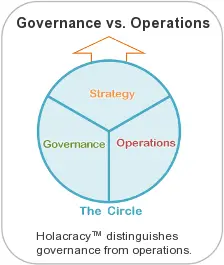
Governance vs. operations
To address these seeming contradictions, we make a distinction in Holacracy between governance and operations. Governance is about how a team will structure itself and work together to achieve its aim – it’s about roles, accountabilities, policies, and processes. Governance decisions use Holacracy’s Integrative Decision-Making process to give everyone a voice and rapidly integrate multiple perspectives.
However, this group process isn’t used to resolve tactical issues or to make specific operational decisions in the normal course of business. Governance in Holacracy defines space for autocratic control and individual action in specific areas, along with appropriate boundaries on such control, so that execution can happen safely and swiftly without the need for a whole-group process. Whenever this delegation of authority needs updating, the team falls back on the governance process to update its governance.